
Methane Pyrolysis for hydrogen production
This is a closer look brief published by the Center for Climate and Energy Solutions (C2ES) in September 2025. The report examines methane pyrolysis (MP) as an emerging, clean hydrogen production method.Overview of Methane Pyrolysis (MP)Methane pyrolysis (MP) is a clean hydrogen production method that splits methane into hydrogen and solid carbon, avoiding direct carbon dioxide emissions. For every kilogram of hydrogen produced, approximately three kilograms of solid carbon are also generated. A key feature of MP is the potential for a dual-revenue model by producing valuable carbon co-products, which can improve the economic resilience and scalability of clean hydrogen.Advantages of Methane PyrolysisThe report outlines several key advantages of MP over other clean hydrogen pathways like Steam-Methane Reforming with Carbon Capture (SMR with CCS) and electrolysis:
Cost Competitiveness: The opportunity to generate revenue from the solid carbon co-product can offset the cost of hydrogen, potentially making MP systems cost-competitive with SMR with CCS.
Broad Geographic Deployment: MP production can be located anywhere a sufficient natural gas hookup is accessible, enabling modular and distributed on-site production. This is critical for mitigating high distribution and storage costs associated with centralized production models.
Resource Consumption: MP uses less electricity than electrolysis and significantly less water than both electrolysis and SMR, making it advantageous in resource-constrained regions.
Modularity: Several companies are developing compact, modular MP reactors capable of producing around one ton of hydrogen per day, allowing users to scale production by adding more units.
Resource and Emissions Comparison
The report provides a comparison of resource consumption and lifecycle emissions for various hydrogen production methods, highlighting the relative benefits of MP:
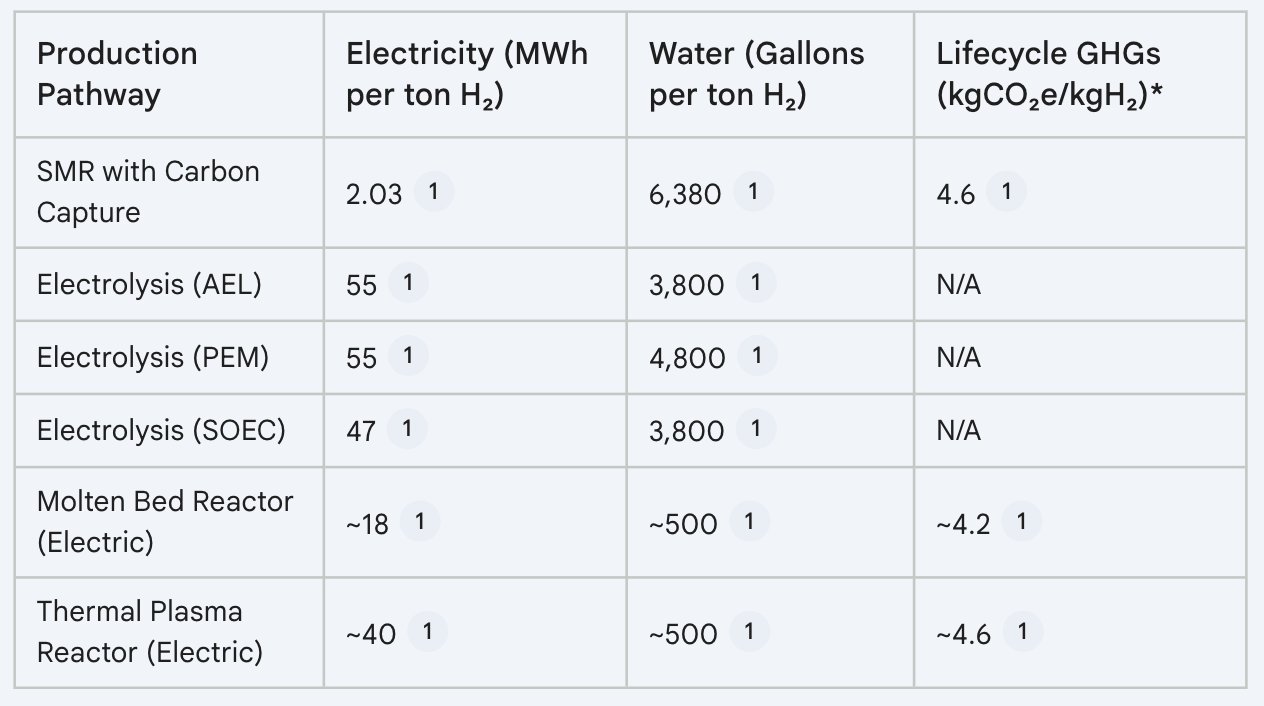
*Note: Lifecycle Greenhouse Gas (GHG) figures for SMR with CCS are a reference LCA value. Lifecycle GHG figures for MP molten reactor and thermal plasma are 'Reference LCA' values from one study. Values for MP are estimates based on company data and modeling.Carbon Co-Products and Market PotentialThe viability of MP largely depends on the market size and quality of the solid carbon co-product. The report discusses three primary carbon products:
Carbon Black (CB):
Value: $400–$2,000 per ton.
Global Market: 14.5 million tons in 2021.
Applications: Reinforcing agent in rubber products (like tires), inks, coatings, and plastics.
Market Constraint: The current CB market size is relatively small, only requiring about five million tons of hydrogen (half of U.S. demand) to be fulfilled by MP systems. Some developers are exploring producing larger, sand-sized particles for high-volume applications like concrete and asphalt to access a larger market.
Graphite and Substitutes:
Value (Synthetic Graphite): $9,500–$10,500 per ton.
Global Market (Synthetic): 1.9 million tons in 2020.
Applications: Critical components in battery and energy storage technology, aluminum and steel production, and industrial applications.
Relevance: MP-produced carbon has the potential to replace imported natural and synthetic graphite and can serve as a cleaner production method.
Carbon Nanotubes (CNTs):
Value: $100/kg ($100,000/ton) for multi-walled CNT.
Global Market: 4,382 tons in 2020.
Applications: Advanced material applications in aerospace, defense, medical, and energy storage.
Market Constraint: The CNT market is very small, representing a modest amount of potential hydrogen production.
A general trade-off exists between maximizing hydrogen throughput and producing more complex, higher-value carbon products, as more complex structures require longer reaction times.
Policy and Commercialization Challenges
To accelerate commercial success, the report suggests public policy support in the form of research funding, tax support, and incentives for using cleaner domestic hydrogen and carbon products. A critical challenge for large-scale commercialization is ensuring the carbon co-product meets the specifications to be valuable in existing or new carbon markets. Another key issue for the lifecycle emissions of MP is the mitigation of methane leakage in the natural gas supply chain.